Family travel guide
Fremantle with kids — a harbour day you can leave
Train in, walk the working port, pick one indoor room, eat early, and treat the station as a valid exit. Fremantle is a Saturday that still works when you lower the ambitions.
Fremantle is the domestic pattern this site keeps recommending because it is honest. It is a port. It smells like a port. You can walk beside water without buying a theme. You can sit. You can leave. The old travelingwithkids.com.au post treated a Fremantle day as an obvious good idea; the rebuild treats it as a worked example of how to design any city outing with children.
You do not need to “do Fremantle.” You need a radius: station, harbour, one indoor room that will let you walk out, food before anyone is desperate, shade. If that radius fills the hours until the toddler’s eyes go square, you have succeeded. If you add a second suburb, a sunset elsewhere, and a dinner reservation, you have designed a different day for different people.
Start with the train, not the car
A car to Fremantle with children is a parking problem wearing a day-trip costume. A train is already an outing. Children understand trains. The ride is the first attraction, which means the destination can be quieter. Check current services with the operator; we do not publish timetables, and we will not invent a frequency. Travel off the crush if you can. Carry water. Sit near a door if you may need to get off and reset.
The station is not only an arrival. It is the exit you promised yourself. When the day turns, you already know the way out. That knowledge changes how bravely you can enter a museum. You can leave. Say it out loud before you go in.
The harbour is the museum you do not have to pay for
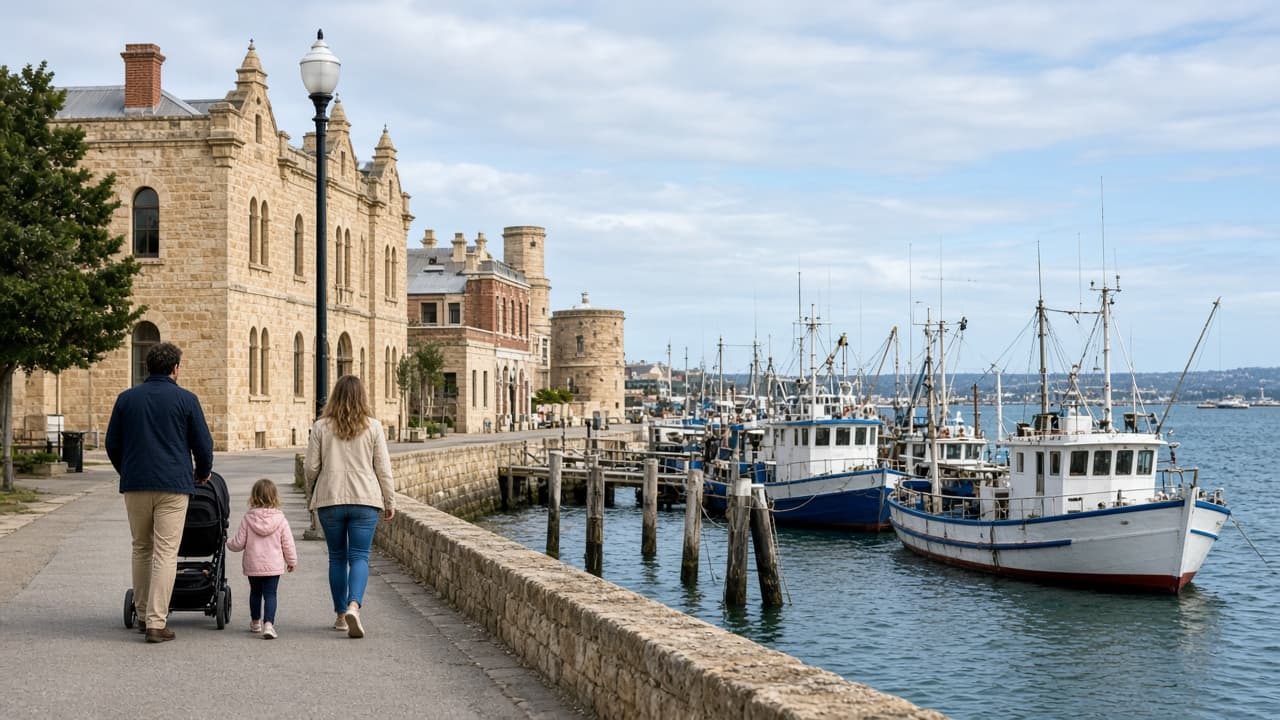
Walk toward the working water. Boats are moving objects at child height. Ropes, gulls, men in high-vis, a fence you can hold. You do not need to narrate the economic history of the port unless you want to. You need to go slowly enough that a child can point.
Shade and wind trade places here. Fremantle can be bright and it can be a wind tunnel. Hats that work in still air leave in the Fremantle afternoon. Pack the hat that stays, or sit in a courtyard. The limestone is pretty. The limestone is also a glare machine. Sunglasses for adults are not vanity; they are how you keep watching the child instead of squinting at the pretty.
There is no obligation to cover both “sides” of the waterfront. Pick a direction. Turn around when the ice-cream logic starts (everyone is sticky and no one is having a peak experience). Sticky is information.
One indoor room, not a cultural itinerary
Fremantle has indoor rooms worth entering: maritime collections, small museums, places with air-conditioning and toilets. Choose one. Read the current hours on the venue’s own page the morning you go. We will not list ticket prices or claim a family discount that may not exist. Historical names from the old blog are unverified.
The rule for museums with toddlers is the same in Fremantle as in Hong Kong or New York: the first interesting room is the visit. The gift shop is optional. The café is a maybe. The second wing is how you collect a tantrum you will then have to carry to the train.
If the indoor room has a ship you can stand on, that is often enough. If it does not, a single aquarium tank or a single large object will do. Children do not owe you the full narrative arc of Western Australian seafaring.
Food on Fremantle time
Eat early. Port towns fill. Queues that are charming at 11.40am are grim at 1.10pm with a toddler. A bakery, a simple lunch, a picnic if you have a fridge bag — the method is more important than the cuisine. Dining with children is the general essay; Fremantle is just the setting.
Coffee for adults is allowed. Coffee as a forty-minute wait while a child stands on a bench is not a rest stop. It is a high-wire act. Take turns if you have two adults. If you have one adult, take the coffee in a paper cup and keep moving. This is not a moral position about cafés. It is maths.
What not to bolt on
Do not bolt on a winery, a full shopping mission, and a sunset at a second beach. Do not treat Fremantle as the first stamp in a “south of the river” passport. The old blog sometimes stacked days because the internet rewarded stacking. Children do not reward stacking.
Markets, if they are on, are a maybe. Check whether they are actually on — we will not invent a market day. Crowds plus small hands plus things at knock-over height is a supervision problem. Go early or skip.
Playgrounds, if you pass one that is in shade, are not a distraction from the “real” outing. They are the real outing wearing a different shirt. Ten minutes of climbing can buy you another twenty minutes of walking. That is a fair trade.
Practical information you must re-verify
Trains, venue hours, ferry ideas, and any paid attraction change. Operator websites win. Weather warnings on official bureau pages win. If you are driving instead of taking the train, child restraints are the state rule — Western Australia’s road-safety guidance and the specific child-restraint page current at the time you travel, not this paragraph. We will not tell you which seat.
If someone in the party has a health question — heat, asthma in wind, a child who is already unwell — that is Healthdirect and a clinician, not a day-trip blog.
Why Fremantle is the template
The Australia hub uses this day as a pattern: movement plus water plus an exit. Glenelg does it with a tram. A Gold Coast corner does it with a short walk back to the room. You can steal the pattern without coming to Perth. If you are in Perth, you can steal the port without turning it into a project.
Go. Walk. Sit. Leave. That is a complete Fremantle day with kids. The limestone will still be there when they are old enough to care who built it.
A timed sketch you can ignore
Late morning train. Harbour walk until the first sticky moment. One indoor room or none. Lunch before one. Shade. Playground if you pass it. Train when the eyes go square. Home before anyone needs to be impressive. If you only do the harbour and the train, you did Fremantle. The limestone does not keep attendance.
What to check that morning
Operator train information. Venue hours if you picked an indoor room. Weather. If you are driving, parking and the child-restraint you already should have right. We will not invent a parking price.
Why this page is long
Because city days die by a thousand additions. The length is a fence. Stay inside it. If you want a second suburb, that is a second day. Fremantle will still be a port tomorrow.
A planning notebook for a Fremantle Saturday
Start with the scene you are actually buying: train, harbour fence, one indoor room or none. If your notes still say “see everything,” you are not planning a Fremantle Saturday yet. You are collecting. Collecting is how afternoons collapse. Write the scene in one sentence a child could hear. If they would not understand the sentence, the plan is still for a different family.
The tool that matters here is the station as a promised exit. It is not glamorous. It does not photograph. It is how 3pm stays kind. Put it on the list before you put a viewpoint on the list. If you cannot afford the tool — in money, in luggage, or in patience — you cannot afford this version of the trip. Choose a smaller version. Smaller is not failure.
The mistake this page exists to prevent is stacking a winery and a second sunset onto a nap window. Families do it because the internet rewards it and because adults remember being the kind of traveller who could improvise. Children are not a failure of improvisation. They are a design constraint. Design for them and the day looks ordinary. Ordinary is the point.
Official reading, not optional: operator train info and venue hours that morning. Read it when you book and again the week you go. Friends describe another year. Forums describe another child. You have this child, this year, this rule. If a clinician or an authority says no, that is the plan. This notebook will not argue.
A morning that works looks like this: harbour until sticky, lunch before one, train home. If you only do that morning, you have done the trip. Add extras only if everyone still has a self. Extras are how you pay twice for the same day — once in money, once in recovery.
Say no to covering both sides of the waterfront as a duty. Say yes to boats at child height and a sit. Those two sentences are the whole method wearing local clothes. You can screenshot them. You cannot screenshot judgement. Judgement is sitting down when the sand is too hot, leaving when the eyes go square, watching water instead of filming it, and checking the living page instead of a memory of this one.
If you need a destination after this notebook, return to the hub that sent you here and pick the radius that matches the children you have, not the children you remember being. If you need a stay, send the dull email. If you need a flight, open the infant page. If you need health, stop reading travel writing. The notebook ends where the authority begins.
Pack less than your anxiety wants. Walk slower than your pride wants. Eat earlier than the room considers stylish. Leave while it is still good. That closing is true on a Fremantle harbour, a Sanur path, a Fiji lagoon, a Glenelg tram, a New York playground, a Gold Coast corner, a park queue, and a hire-car driveway. It is not a personality. It is a family travel method, and it is the reason this URL still deserves to resolve.
When you get home, the test is not a stamp count. The test is whether you would repeat a smaller version. If yes, the design worked. If no, change the design: fewer hops, closer water, more kitchen, fewer temples, a later year. The children will still be children. The places will still be places. You do not have to win them in a weekend.
Write one sentence in the notes app before you pay: the 3pm sentence. If you cannot write it, you are not ready to pay. That is not fear. That is planning. Planning is the only adventure this site will sell, and it does not require a ranking to be real.
Keep a short list of what you will not argue about on the trip: bedtime closer to home than to the restaurant; water you can stand in; one paid thing a day; official pages when a topic can hurt. Arguments with a tired child in a queue are expensive. Agree the list at the table at home, in the language you actually speak to each other, then stop reopening it in the sand.
If you are travelling with another adult, split watching and logistics on purpose. One person can be the camera or the coffee. The other person cannot also be the pool fence at the same time. Solo parents should shrink the radius until watching is geometrically possible. That is not a lesser trip. That is geometry.
Weather will edit the notebook. Heat, wind, rain, a fire page, a cyclone page, a swell that arrived overnight: the living warning wins. Swap in the indoor room, the kitchen, the train ride that was already an outing. If your plan cannot survive weather, it was a photoshoot. Photoshoots are optional. Children are not.
When this URL loaded, you may have wanted a shortcut. The shortcut is the 3pm sentence, the tool named above, and the official link. Everything else on the page is there so you do not have to learn those three the hard way in a terminal at midnight. Use them in the afternoon, at the table, before you pay.
Ask a planning question
This is an independent guide, not a booking desk. If a page is unclear, or you want a topic added, send a note — we read every message.